Understand the requirements of HAZMAT transportation and how truck drivers can avoid violations.
HAZMAT transportation can be lucrative for carriers but it requires understanding common Department of Transportation violations and how to avoid them in regards to hazardous materials.
HAZMAT transportation can be extremely dangerous for truck drivers which is why it typically pays at a higher rate. To enforce regulations and promote the safety of HAZMAT transportation, the FMCSA conducts over 154,000 annual roadside inspections, with an estimated 35,000 DOT HAZMAT violations reported. That’s nearly 23 percent of inspections resulting in a violation!
Want to obtain a HAZMAT endorsement on your CDL and potentially earn more with HAZMAT transportation?
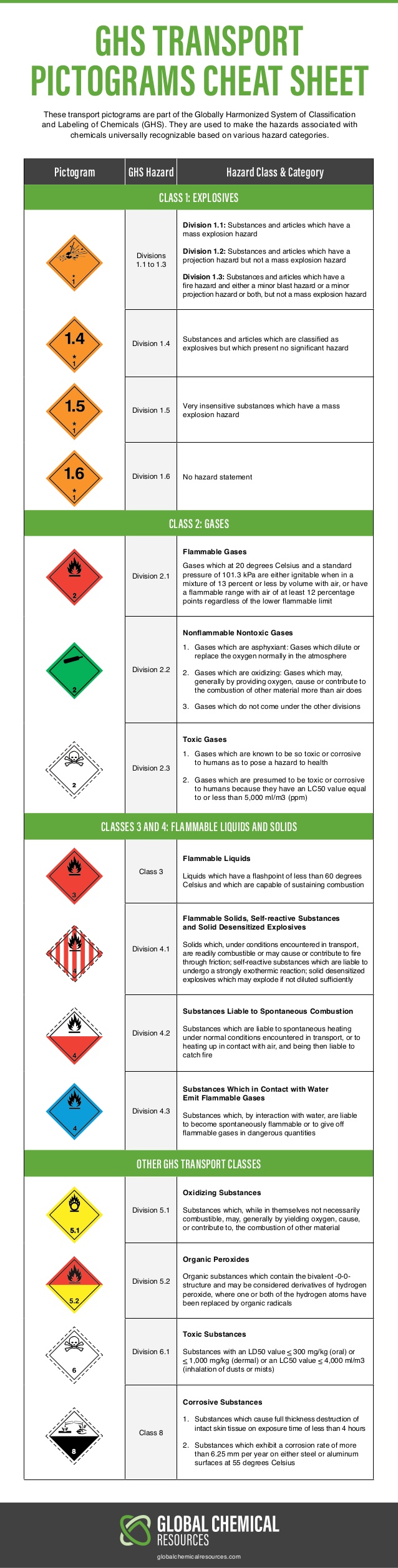
GHS Transport Pictograms Cheat Sheet for hazardous materials from Global Chemical Resources.




Industry Update - June 2, 2020 <h2></h2>
<h3></h3>
<a href="https://truckerpath.com/uploads/2020/06/b21.jpg"><img src="https://truckerpath.com/uploads/2020/06/b21-300x156.jpg" alt="" width="300" height="156" class="alignleft size-medium wp-image-4991" /></a>
<h3><strong>DOT to Distribute 2.1 Million Masks to Truckers</strong></h3>
The U.S. Department of Transportation will distribute around 2.1 million face masks to truck drivers. This is part of a larger initiative to distribute masks to transportation workers across the country.
“Transportation workers are on the frontlines of keeping our transportation systems operational during this public health emergency and their wellbeing and safety is paramount,” said Transportation Secretary Elaine Chao.
DOT announced that the masks will be sent out over the coming weeks through the U.S. Postal Service. The breakdown of masks by transportation sector is as follows:
<ul>
<li>Mass transit and passenger rail – 4.8 million</li>
<li>Aviation – 3.8 million</li>
<li>Maritime – 2.4 million</li>
<li>Freight rail – 2.2 million</li>
<li>Highway and motor carrier – 2.1 million</li>
<li>Pipeline systems – 258,000</li>
</ul>
For detailed distribution locations and current dates of distribution, please visit: <a href="http://www.fmcsa.dot.gov/masks">www.fmcsa.dot.gov/masks</a>
<h2></h2>
<h2></h2>
<a href="https://truckerpath.com/uploads/2020/06/b19.jpeg"><img src="https://truckerpath.com/uploads/2020/06/b19-300x156.jpeg" alt="" width="300" height="156" class="alignleft size-medium wp-image-4988" /></a>
<h3><strong>Volumes Now Up 10% vs Last Year</strong></h3>
<a href="https://www.freightwaves.com/news/volumes-fall-week-over-week-but-now-up-10-year-over-year">Outbound tender volumes are benefiting greatly from the reopening of the economy</a> and a release of pent-up consumer demand. Supply dynamics are taking longer to adjust and capacity remains loose. While rates are coming off a depressed base, spot rates have surged to $1.47 per mile and have increased in the vast majority of lanes.
<h2></h2>
Volumes should continue to be supported by most of the states reopening, continued plugging of the income gap by generous unemployment benefits and stimulus, auto plants reopening, and produce seasons kicking into gear.
<h2></h2>
<h2></h2>
<a href="https://truckerpath.com/uploads/2020/06/b20.jpeg"><img src="https://truckerpath.com/uploads/2020/06/b20-300x156.jpeg" alt="" width="300" height="156" class="alignleft size-medium wp-image-4989" /></a>
<h3><strong>Blinking Lights Cut Tanker-Truck-Crashes By Nearly 34%</strong></h3>
As part of their safety efforts, Groendyke Transport installed $150 blinking amber lights to the back of their tanker trucks. They reported a 33.7% drop in rear-end collisions over a 31-month period, according to company officials. In addition, there were zero rear-end collisions at railroad crossing during a test period of one year and seven months.
<h2></h2>
The Groendyke Transport fleet currently has 900 trailers with the lights after almost three years of testing and now has <a href="https://beta.regulations.gov/document/FMCSA-2018-0223-0036">permission from FMCSA</a> to use them.
<h2></h2>
The cost of the strobe and installation is about $150.
<h2></h2>
<h2></h2>
<h2></h2>
<h4>By Aldous Aldwin</h4>
<h3></h3>
<h3></h3>
Types of Truck Freight [h2] Types of Truck Freight [/h2]
[p] There are many types of truck freight, each with a unique yet important role for moving different truck freight across the nation and load boards make it easy to find truck freight.
[/p]
[h2] Truck Freight [/h2]
[p]Truck freight is responsible for <a href="https://truckerpath.com/blog/trucking-industry-trends/">70 percent of all cargo that is transported in America</a>. That's over 10 billion tons each year![/p]
[p]Companies ship a variety of truck freight ranging in size, value, and contents. Ever wonder how ice cream somehow stays frozen when shipped across America or how huge machines make their way from a factory in Kentucky to a warehouse in California? It's all thanks to truck freight and the specific trailers and equipment necessary for the dedicated men and women of the trucking industry to haul the freight.
[/p]
[h2] Find Truck Freight on Truckloads Load Board[/h2]
[p]If you have <a href="https://truckerpath.com/blog/trucking-authority/">trucking authority</a> and are looking for truck freight loads you can use Truckloads free load board to customize your truck freight search and filter results that are the best fit for you. You can choose from 11 different trailer equipment types when searching for loads and search based on location, date, deadhead and even load weight. [/p]
[p]Use Truckloads web version or download the app and view over three million loads per month including unlimited access to premium loads as well as the ability to call a broker right from the app from anywhere. Stay loaded and know where nearby truck freight loads are with Trucker Path Truckloads![/p]
[button text="Try Truckloads for Free" href="https://truckerpath.com/truckloads/free-load-board/?utm_source=Blog&utm_medium=truckfreight&utm_campaign=Aug10" width="250px"]
[video id=snyBYpnuhWw]
[h2] Flatbed Trucks [/h2]
[p]Flatbed trucks are truck freight with a trailer that is leveled off and open with no sides or top, hence the name flatbed. This design makes it easier to load and unload large freight that otherwise couldn't fit into a standard 53-foot trailer. Truck freight is secured on flatbeds with straps, tarps and other locking devices to keep the load tied down. [/p]
[p]
Generally, flatbed trucks are used as truck freight for construction goods, large manufactured parts, and various oversized loads. An oversized load is any truck freight that is over 8.5 feet wide. This type of truck freight requires red flags and lights to help identify the oversized truck freight on the road.
[/p]
[img src="/uploads/2017/08/Flat-Bed-Final.png" alt="flatbed truck freight"]
[h2] Step Deck Trucks[/h2]
[p] Similar to flatbed trucks, step deck trucks also have a level surface that is open. The main difference between truck freight with a flatbed and step deck truck is that the step deck truck will have a lower position set closer to the ground. This helps truck freight that is taller sit lower to avoid potential hazards such as bridge clearances. [/p]
[img src="/uploads/2017/08/Step-Deck-Final.png" alt="step deck truck freight"]
[h2] Reefer Trucks [/h2]
[p]Also known as refrigerated trucks, reefer trucks are truck freight with a trailer that is temperature controlled in order to haul goods that must remain within a certain temperature zone at all times such as food. While reefer trucks commonly haul loads that include perishable foods, they also transport things like pharmaceuticals, chemicals, and other <a href="https://truckerpath.com/blog/hazmat-transportation/">hazmat materials</a>, though not at the same time of course. [/p]
[img src="/uploads/2017/08/Reefer-Final.png" alt="reefer truck freight"]
[h2] Dry Vans [/h2]
[p]Dry vans are the most common truck freight. They are typically a standard 53-foot trailer like the ones you see connected on the back of a semi-truck on the interstate that might say Walmart, Target or Schneider. Although not an actual van, they are the most common truck freight to haul goods, providing a trailer that is sealed and protected from the elements. [/p]
[p]
Look around your home and chances are the things you see were hauled by dry van truck freight. Dry van loads are used by a variety of companies looking to ship anything from consumer products, home goods, electronics, and a variety of other products that don't require refrigeration.
[/p]
[p]
Choosing to haul truck freight with a dry van can result in an increased opportunity in available freight to haul due to the volume of truck freight shippers have for dry vans. [/p]
[img src="/uploads/2017/08/Van-Final.png" alt="Dry Van freight"]
[h2] Other Types of Truck Freight [/h2]
[ul] There are several other truck freight loads you'll find as well, including:
[p]
[li]Auto Carrier - trailer that hauls automobiles and other vehicles[/li]
[img src="/uploads/2017/08/Auto-Trailer-Final.png" alt="auto carrier freight"]
[li] Dump Trailer - trailer with a lift to incline and allow for loads to be dumped [/li]
[img src="/uploads/2017/08/dump-trailer-Final.png" alt="dump trailer freight"]
[li] Tanker - trailer that is a long cylinder shape hauling liquids like fuel[/li]
[img src="/uploads/2017/08/Tanker-Final.png" alt="tanker truck freight"]
[/ul]
Trucker Path integrates with McLeod TMS
[p]Trucker Path Truckloads has integrated with McLeod TMS to provide more efficient freight posting.[/p]
[p]Trucker Path, creators of America’s most popular apps in the trucking industry, announced that its freight-matching marketplace Truckloads is now integrated with McLeod TMS Software – an advanced transportation management software for carriers, brokers, and shippers.[/p]
[quote]“The integration of the McLeod Software system within Truckloads allows our mutual customers a simplified upload process to display their freight for the hard to reach over-the-road drivers that depend on mobile technology to find available loads,” said Leigh Foxall, Vice President of Sales at Trucker Path.[/quote]
[p]With this integration, McLeod users can post freight directly to the Truckloads platform through the McLeod TMS where over 85,000 qualified carriers in Truckloads can access them.[/p]
[quote]“McLeod Software is always in search of ways to make the process of offering loads to carriers more streamlined and efficient,” said Robert Brothers, Manager of Product Development at McLeod.[/quote]
[quote]“For this reason, we believe the Truckloads platform will be a perfect fit with our software. Partnering with Trucker Path will keep us more intimately connected with our customers’ needs.”[/quote]
[img src="https://truckerpath.com/uploads/2017/04/truckloads-mockup-computer-1.png" alt=""]
[p]Publicly released in March 2016, Truckloads freight platform is available on both web and mobile via the app which has over 300,000 installs across iOS and Android devices – the most of any mobile load board app. Truckloads features over 2.5 million monthly loads and its network of carriers, brokers, and shippers have experienced a steady 20 percent monthly growth rate.[/p]
[quote]“The innovative Truckloads freight platform, allows companies to post freight without paying a monthly fee, contributing to its success as the fastest growing load board in the industry,” Foxall said.[/quote]
[quote]“This new integration is significant in providing greater efficiencies for McLeod users, furthering Truckloads advancements compared to its competitors.”[/quote]
[p]Carriers and brokers can use Truckloads network free of charge, with customized freight searches for carriers including eight different filtering criteria, unlimited access to premium loads as well as the ability to view a broker's’ credit score and days to pay. Mobile Truckloads users can make calls inquiring about a load directly from the app.[/p]
[p]Carriers can also receive push notifications sent directly to their mobile devices when new loads match their criteria. Meanwhile, brokers can easily access information on the number of times a specific load has been viewed by a carrier to assist in moving freight faster and more efficiently.[/p]