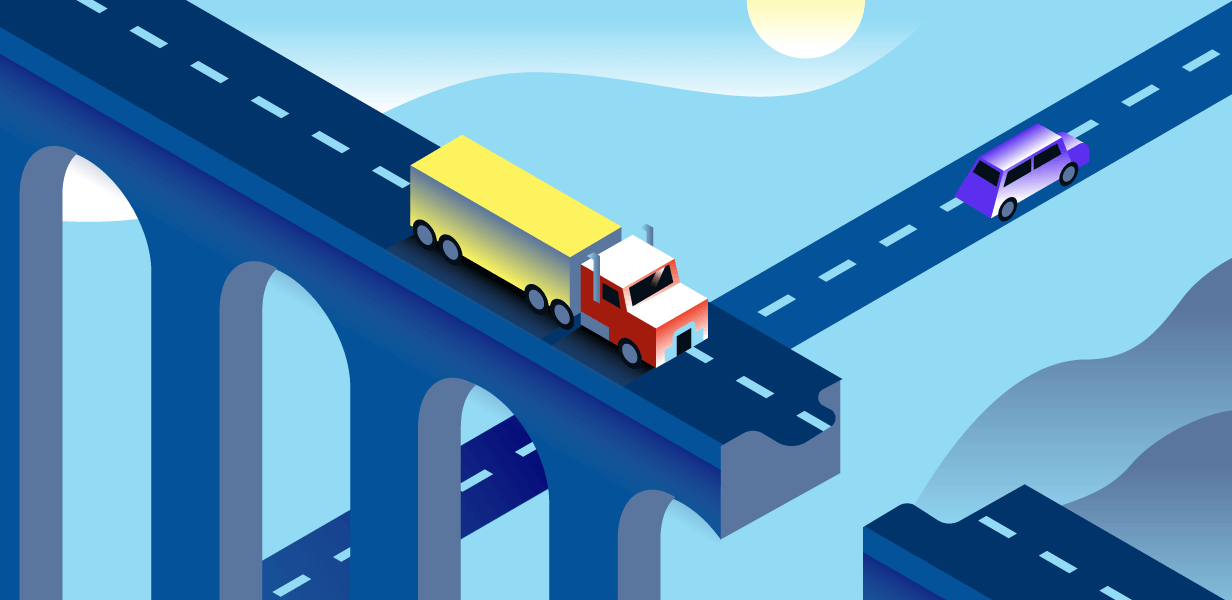
America, land of the free, home of the brave, potholes and faulty bridges. Truck drivers take to the roads of America each and every day, hauling freight and delivering the things we desire most while others drive to work, visit loved ones or travel for vacation. In honor of National Infrastructure Week here are the worst roads in America ranked by state.
Rankings for the worst roads in America are broken down by state and based on the percentage of roads in poor or mediocre condition with data sourced from the Federal Highway Administration.
These states have the least percentage of roads in poor or mediocre condition, making them the best roads in America.
Rankings are based on bridges considered structurally deficient or functionally obsolete with data sourced from the Federal Highway Administration. (Hawaii and Alaska excluded)
These states have the least percentage of bridges not considered structurally deficient or functionally obsolete.
May 15–19 is National Infrastructure Week, a time to educate, plan and generate opportunities to rebuild our nation’s roads, bridges and more. The American Society of Civil Engineers estimates $3.6 trillion is necessary to raise the standard of infrastructure level. Meanwhile, President Trump has proposed a $1 trillion infrastructure plan with details to be revealed soon says Secretary of Transportation, Elaine Chao.
“We’ve been hard at work at this, and so we’ll be releasing principles in about two to three weeks and then the legislative proposal will probably be tackled by the Congress in the third quarter,” Chao said.




Industry Update - November 22, 2019 <h4><strong>By Paul DeCoste</strong></h4>
<h3><strong>Did you Know?</strong></h3>
The trucker-themed movie, <a href="https://en.wikipedia.org/wiki/Roadgames">Roadgames</a>, came out this week almost 30 years ago. On November 19<sup>th</sup>, 1981. Starring Stacy Keach and Jamie Lee Curtis, this film is a personal favorite of Quentin Tarantino.
<h3></h3>
<h3><strong>Industry Update</strong></h3>
The <a href="https://globalnews.ca/news/6199178/cn-rail-strike-3rd-day/">strike at CN Railway</a>, Canada’s largest railroad, has entered its third day. 3,200 unionized workers began their strike on Thursday, and it has been recorded as the biggest company strike in a decade. The union is mainly fighting against worker fatigue and making sure that worker’s breaks are not reduced.
<h3></h3>
CN’s stock has slowly fell by 3$ over the past three days of this strike.
<h3></h3>
<h3><strong>Regulations</strong></h3>
House Democrats in Connecticut want the governor to <a href="https://cdllife.com/2019/dems-tell-connecticut-governor-to-revive-truck-only-toll-plan/">rethink a plan that will only toll commercial vehicles on 12 bridges throughout the state</a>. The funding plan, officially titled “CT2030”, will only toll semi-trucks and other commercial vehicles and is estimated to rake in $150 million in revenue per year. The Connecticut House Speaker, Joe Aresimowicz, argues that commercial vehicles do majority of the damage to interstate roads and therefore, should be tolled at a rate that is 7x higher than the rate for passenger vehicles.
<h3></h3>
Governor Lamont has since stated that, “the truck-only option provides too little revenue, too slowly and too piecemeal to make a meaningful difference.” For the time being, highway tolls in Connecticut will remain the same to all vehicles that pay their fees.
<h3></h3>
<h3><strong>ELD Update</strong></h3>
<a href="https://www.ttnews.com/articles/uber-freight-subsidizes-geotab-elds-0">Uber has recently partnered with Geotab and announced an interesting deal</a> to supply small carriers with their ELD service. Small carriers with 10 trucks or fewer are eligible to receive a free Geotab ELD as well as a free year of Uber Freight services. However, there’s a catch.
<h3></h3>
Carriers that accept this deal must agree to share their telematics data with Uber Freight. The breakdown of exactly what kind of data will be shared has yet to be announced but the value of telematics data has been on the rise in recent years and there is not telling how much valuable information you could end up giving away.
<h3></h3>
<h3>"Movember"</h3>
<a href="https://www.trucker.com/drivers/maxitrans-supporting-mens-health-movember-drive">MaxiTRANS is an Australian trailer manufacturer and they are using “Movember” to raise awareness</a> for mins health issues. Issues that include prostate and testicular cancer, mental health and suicide prevention. The company even commissioned an entire reefer trailer that is branded with Movember on all walls.
7 Tips on Healthy Eating For Truck Drivers [h2] Healthy Eating for Truck Drivers [/h2]
[p]It's never too late to rediscover healthy eating habits especially healthy eating for truck drivers. Here are seven tips to help promote better nutrition and healthy eating for truck drivers.[/p]
[p]Sure, it's easy to swing by a [a href="https://app.appsflyer.com/com.sixdays.truckerpath?pid=Social Facebook"]truck stop near you[/a] and grab a few cheese-smothered chili dogs, but that offers no nutritional benefits to healthy eating for truck drivers. The goal should be to create healthy habits and make it a lifestyle. These habits should be deeper than just what you eat, but also when you eat and how your shop for your food.[/p]
[h2]1. How Often Should I Eat?[/h2]
[p]Before we talk about shopping and cooking we should talk about something extremely important: eating. Our society and the trucking industry has been organized around the idea that people should only eat about 3 times a day. For healthy eating for truck drivers, this is not necessarily the best choice. [/p]
[p]While this might be more efficient in terms of consuming maximum calories in minimum time and getting back on the road, it is not always the best plan for your health. Instead, aim for around five smaller meals each day. This might seem crazy but it is necessary to metabolize food more efficiently.[/p]
[h2]2. How Our Body Processes Food[/h2]
[p]Your body is designed to absorb calories, use them for energy and then burn them off. In order for your body to make use of the food, what you eat has to be broken down into a form of sugar called glucose. This is a natural process and for most, the human body does this quite well. You have probably heard people talking about their “blood sugar level”, and what they are referring to is the amount of glucose in their blood.[/p]
[giphy]<iframe src="https://giphy.com/embed/kVVEP6SmfEXvy" width="480" height="269" frameBorder="0" class="giphy-embed" allowFullScreen></iframe>[/giphy]
[h2]3. Why Should I Care About My Blood Sugar Levels?[/h2]
[p]Your body has a normal range for the amount of [a href="https://thehungryhauler.com/"]glucose in your blood[/a] (between 4.0 and 11.0) and it has a beautiful system for managing that level. Hormones like insulin keep your blood sugar from getting too high and becoming toxic, and another awesome compound, glucagon keeps your sugar from getting too low and making you pass out. It is something like a highway with really good guard rails that keep a truck from running off the road.[/p]
[p]The only problem is that it is possible to overwhelm this excellent system and cause a wreck. Actually, many people are overwhelming it every day and causing small “fender benders” that lead to a total cataclysm later in life called diabetes.[/p]
[p]So why does this make eating only three times per day (or fewer) a bad idea? Because you can end up constantly overwhelming the system with extreme blood sugar highs and lows. If you wait to eat until you are extremely hungry and have very low blood sugar, your body will send the signal that you are starving, and when you do eat it is often much easier to overeat unhealthy and convenient food. Healthy eating for truck drivers requires you to eat when you're hungry and avoid a severe dip in blood sugar.[/p]
[h2]4. How Much Should I Be Eating?[/h2]
[p]Some people conclude that the solution is to simply eat drastically less overall and there is a grain of truth to this. While dramatically reducing your caloric intake does cause the body to burn stored fat to stay alive, it can signal your body to store everything you do eat, which results in rebound weight gain when you do return to a more normal diet. Starving yourself is not the answer.[/p]
[p]Thankfully there is a much better way. Simply, eat a reasonable amount of food more often. Eating five or six smaller and healthier meals per day is like steering down the middle of your lane instead of bouncing your truck off the guard rails all day. This practice will help you feel more content and stop your body from deciding to store fat for hibernation. Of course, if you eat more often and end up eating more food overall you will still have trouble being healthy. The objective is to eat an appropriate amount of food, in a more sustainable way. Typically, 2,000–2,500 daily calories are suggested; however, consulting a healthcare professional is the best way to understand what an appropriate daily caloric intake means for your individual health needs.[/p]
[giphy]<iframe src="https://giphy.com/embed/xtgZt3jZelFqU" width="480" height="269" frameBorder="0" class="giphy-embed" allowFullScreen></iframe>[/giphy]
[h2]5. What Are the Benefits to Eating More Often?[/h2]
[p]There is also an enormous safety benefit to eating more often and avoiding the blood sugar spikes: you are less likely to feel drowsy at the wheel. Most people have experienced the after dinner slump that makes it all but impossible to keep your eyes open after a big meal. That might be fine after Christmas dinner when you are lounging on the couch at home, but at work, behind the wheel of an 80,000 pound-plus rig, it can be a disaster.[/p]
[h2]6. How Do I Plan My Meals?[/h2]
[p]You might be wondering: how on earth is it possible to eat five or more meals per day? Who has the time to stop for food that often? There is a way to make your diet much simpler, more healthy, easier to sustain over the long term, and much less expensive! The key is to learn to shop for your own food and cook for yourself on the road. It is much easier than it may sound, and the rewards for your health and happiness are amazing! It will even allow you to have more freedom to implement your doctor's specific recommendations.[/p]
[h2]7. Eat What You Want. Sort of[/h2]
[p]Anyone who has dealt with eating healthier has heard the term portion control. Controlling what, how much, how often you eat and making sensible, sustainable choices is the path to solving many of the health risks of the trucking lifestyle. To eat healthier you don't have to give up all of your favorite foods and consume a spinach and carrot based diet like a rabbit. Instead of going to the extreme, eating a balanced diet will keep you “between the lines” and on the road to better health. Extremes are by nature quite unsustainable and will not help you. Just like over-steering on the highway to avoid a crash can actually end up killing you, bouncing from one diet extreme to another, like chili-dogs to rabbit food, will just leave your lifestyle in a bewildering wreck.[/p]
[giphy]<iframe src="https://giphy.com/embed/n2v0V9cSmTQnS" width="480" height="269" frameBorder="0" class="giphy-embed" allowFullScreen></iframe>[/giphy]
[p]The cornerstone of a healthy life is healthy eating for truck drivers. Eating healthy is difficult for truck drivers who are on the road for weeks at a time. Most trucks aren’t designed with a fully equipped kitchen or proper food storage. Even if you can manage to find space for some cooking gear, it is often difficult to consistently find time in a busy schedule to prepare a good meal. We all want to be around long enough to enjoy time with our families and loved ones. The best way to ensure this is to focus on eating healthier as a truck driver.[/p]
[p]By: [a href="https://thehungryhauler.com/"]John Heslop[/a][/p]