Find truck parking near you with the new Trucker Path Truck Parking feature.
If you’re a truck driver, then you’re well aware of the lack of available truck parking in America. It’s one of the top issues plaguing the trucking industry and is both a safety risk for drivers and costs trucking companies billions.
We discovered that almost half of the truck drivers spend an hour or more searching for available truck parking. Between the ELD mandate and overcrowded truck stops, it’s no surprise. Still, the burden shouldn’t be left on the drivers. They have enough to worry about, after all, being a truck driver is one of the most dangerous jobs in America.
Now there’s a solution to finding truck parking with our new Parking Predictor!
This new parking feature compiles several years of data to forecast the availability of parking at truck stops and other locations. Now you can compare specific times of day at over 8,000 locations to see when parking is either full or has spots for trucks.
How To Use It:
1. Open the Trucker Path app
2. Click on a Location found on the map
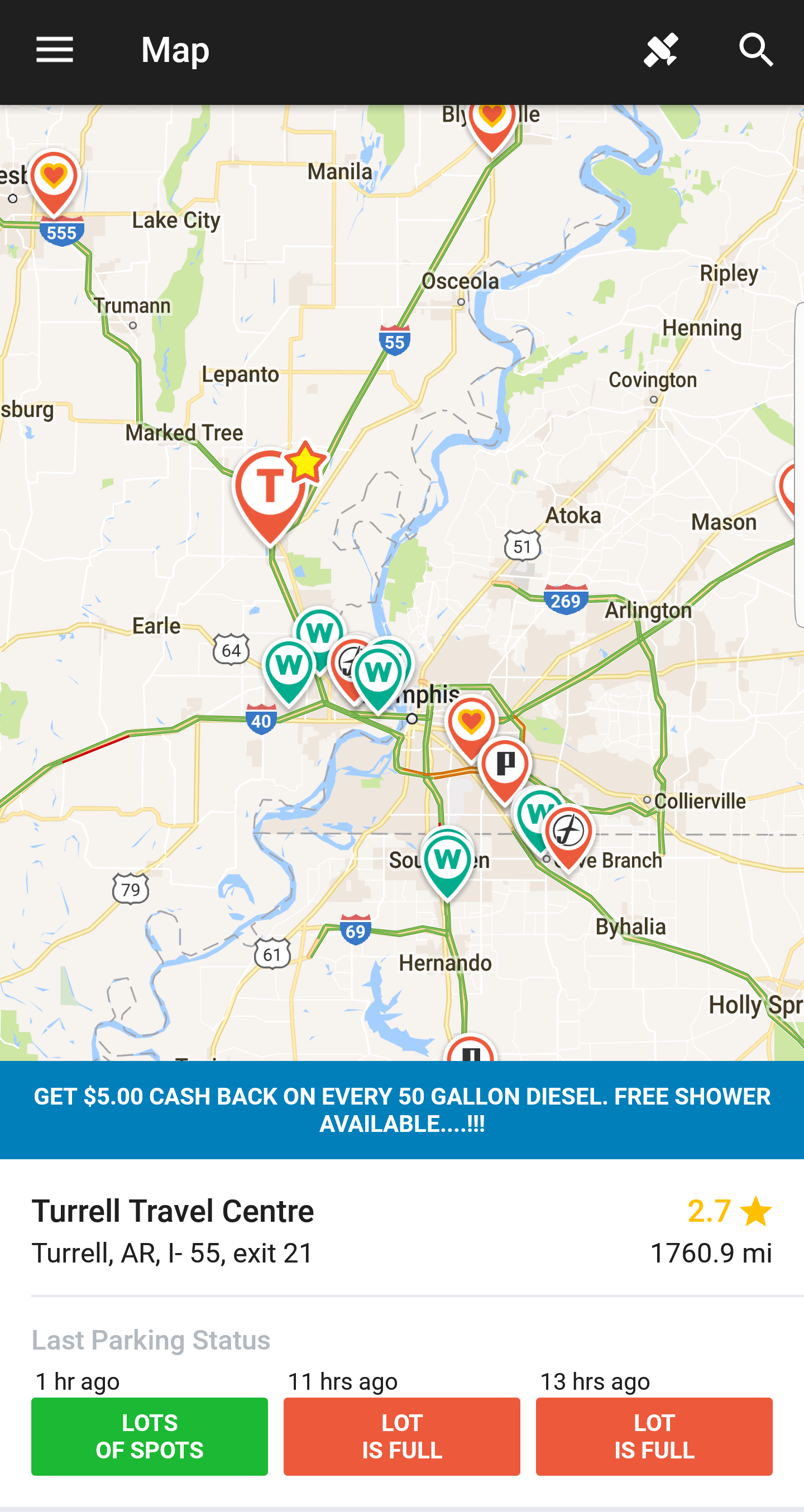
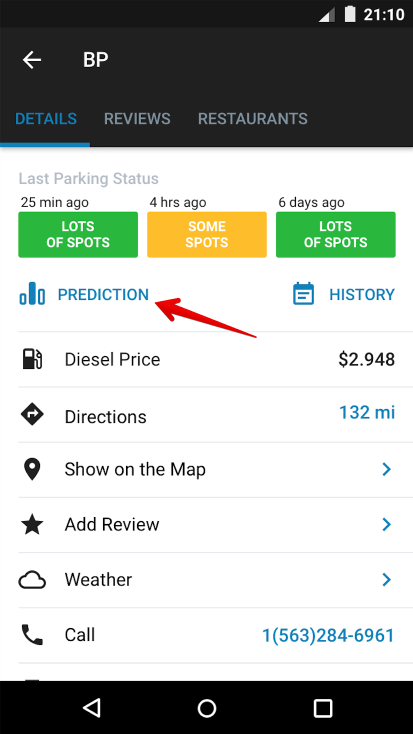
3. Click PREDICTION
4. View the Parking Predictions to verify when the best (and worst) times to park at the location will be.
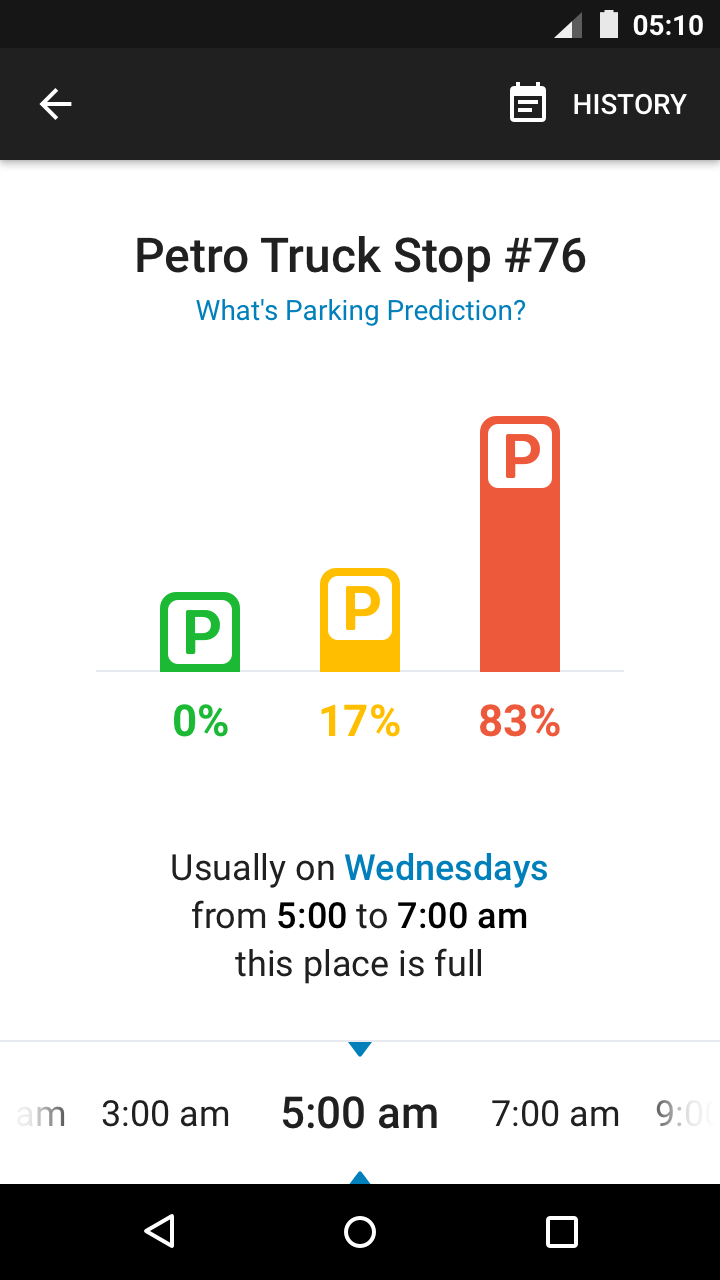
Truck Parking looks limited at this place Wednesday mornings, you might want to find an alternative location.
It’s as easy as that! Now you can eliminate wasted time searching for a spot and find nearby truck parking with confidence. A little peace of mind goes a long way and you won’t have to worry about violating your HOS with this new feature.



Brake Safety Week is almost here. Are you ready? [p]Are you ready for the Commercial Vehicle Safety Alliance’s (CVSA) Brake Safety Week happening later this month? From September 16-22, CVSA-certified inspectors will conduct a weeklong inspection blitz throughout the U.S. and Canada focusing on brake systems. CVSA reported that 14 percent of truck drivers were placed out-of-service for brake-related violations during last year’s Brake Safety Day. Getting placed out-of-service costs drivers valuable time and money, so it’s important that you don’t find yourself in the same situation. Making sure you’re prepared will not only help you pass an inspection and keep you moving, but it will also make our roadways a safer place.
[p]Most inspections during the blitz will be full Level I inspections. This comprehensive 37-step procedure examines driver operating requirements and vehicle mechanical fitness, and will also focus on the inspection of:
<ul>
<li>Brake-system components to identify loose or missing parts</li>
<li>air or hydraulic fluid leaks</li>
<li>defective rotor conditions</li>
<li>measurement of pushrod travel</li>
<li>mismatched air chamber sizes across axles</li>
<li>air reservoir integrity and mounting</li>
<li>worn linings, pads, drums or rotors</li>
<li>required brake-system warning devices</li>
<li>other brake-system components</li>
</ul>
[p]There will also be 12 jurisdictions using performance-based brake testing equipment to measure vehicle braking efficiency.
[p]So, what can you do to be ready for your inspection?
<ul>
<li>Have your driver’s license and registration easily available.</li>
<li>Perform your regular preventative maintenance procedures.</li>
<li>Conduct your pre-trip visual inspection. Make sure to look for loose hoses, leaks and any damage; check air disc brakes for cracks and grooving; and ensure air chambers are intact and in the correct position.</li>
<li>Inspect brakes more in-depth looking for leaks, checking brake linings for cracks and wear, and measuring the brake stroke, etc.</li>
<li>Utilize the Trucker Path app to see inspection facilities and get an idea of when you might expect to receive an inspection during the blitz.</li>
</ul>
[p]We hope these tips will help make your inspection go smoothly. It’s also important to remember that it’s a best practice to always keep your truck well-maintained, inspect your brake systems regularly, and perform a thorough pre-trip inspection before every trip. You still have time to address any issues and get yourself and your truck ready for the 2018 CVSA Brake Safety Week!
How to Start a Hotshot Trucking Business
[p]Ever wondered how to be your own boss while enjoying beautiful sceneries across America?
The freight industry is the backbone of America’s economy contributing more than <a href="https://tradingeconomics.com/united-states/gdp-from-transport">500 billion USD</a> every quarter and the numbers are increasing each year. It’s a lucrative industry which gives handsome rewards. However, it is not easy getting into traditional trucking due to the requirements needed.[/p]
[p]What if there was a way to be a part of the trucking industry without dealing with all the hassle? The good news is there is a sure-fire way of being a part of the trucking industry and you can get started in a few days. What is it, you ask? The answer to that question is “Hotshot Trucking”. But there are still a few requirements before you are eligible to haul freight. Fortunately, these requirements are easy to complete and we will explain everything step by step below.
[/p]
<h2></h2>
[p][b]What is Hotshot trucking? [/b][/p]
[p]Hotshot truck drivers are freelancers who work privately carrying freight from one point to the other without any employer restrictions or scheduling restrictions. In other words, you are your boss and you can choose when to earn and how much to earn. All you need is a medium or heavy-duty truck with at least 7,000 pounds of hauling force and a trailer. A Dodge Ram 3500, a Toyota Tacoma, or any version of the Ford F-series truck can work well. [/p]
[p]Currently, around 70% of the goods you can find on the shelves are transported by hotshot truckers and independent freight transporters. According to estimates, the trucking industry is expected to grow by 2.3% yearly till 2024. With freight volumes increasing day by day it is the perfect time to set up your own hotshot trucking business.
[/p]
[p][b]Pros and cons of Hotshot Trucking?[/b][/p]
[p]Hotshot Trucking comes with a lot of advantages especially if you want to kick-off your trucking business easily. But be wary also of some limitations and trade-offs when entering this kind of trucking business.
[/p]
[img src="https://truckerpath.com/uploads/2020/10/How-to-Start-a-Hotshot-Trucking-Business-pros_and_cons_table.png" alt=""]
[p][b]How to Begin?[/b][/p]
[p]Now that you have a basic idea of hotshot trucking let’s get started on the specifics: [/p]
<h2></h2>
[p][b]Set up an LLC[/b][/p]
[p]You need to set up a Limited Liability Company (LLC) and register it with your state. This is the first step in registering your business and it doesn't matter if you are working alone or if you intend to invite others to join in with you, setting up a legal company gives you many <a href="https://www.legalzoom.com/articles/advantages-of-an-llc">benefits</a> such as:[/p]
<ul>
<li>Limited personal liability</li>
<li>Less paperwork</li>
<li>Tax advantages</li>
<li>Ownership and Management flexibility</li>
<li>Flexible profit distribution</li>
</ul>
[p][b]Register With the Tax Authorities [/b][/p]
[p]Once you have your LLC set up, the next step is to get a <a href="https://www.irs.gov/individuals/international-taxpayers/taxpayer-identification-numbers-tin">Tax ID</a> to go with your business. The tax ID or the Employer Identification Number (EIN) will allow you to receive checks and other forms of payments directly to your business account. That takes us to our next step. [/p]
<h2></h2>
[img src="https://truckerpath.com/uploads/2020/10/How-to-Start-a-Hotshot-Trucking-Business-make_a_business_bank_account.jpg" alt=""]
[p][b]Make a Business Bank Account[/b][/p]
[p]A separate bank account will allow you to divert all your business-related transactions to your business bank account. This allows you to keep track of your expenditures while also giving you the liberty to make and receive payments.[/p]
[p][b]Apply for a CDL (optional)[/b][/p]
[p]Hotshot trucking does not require a commercial driver’s license (CDL) since in most cases you won’t be exceeding the gross weight limit determined by the authorities. [/p]
[p]You don’t need a CDL if: [/p]
<ul>
<li>If the total weight you are pulling is less than 10,000 pounds.</li>
<li>If the combined weight of the vehicle and trailer is less than 26,000 pounds. </li>
</ul>
[p]Getting a CDL is no easy task. You have to enlist in a reputable training academy, go through several weeks of training, and then apply as well as pass the CDL exam. Therefore, it is better to forego this requirement in the early stages of your business but its best to acquire the license once your business is up and running.
[/p]
<h2></h2>
[img src="https://truckerpath.com/uploads/2020/10/How-to-Start-a-Hotshot-Trucking-Business-acquire_relevant_equipment-1.jpg" alt=""]
[p][b]Acquire Relevant Equipment [/b][/p]
[p]As you know, hotshot trucking involves a lot of hauling and towing. It is important to have a sturdy and reliable truck if you want to save yourself a lot of grief later. You will need a good medium to heavy-duty truck with a lot of power (around 400HP) to pull at least a ton and a 30 ft. gooseneck flatbed trailer to begin. A decent truck can cost from $15,000 to $60,000. A good trailer costs from $7,000 to $25,000. It is up to you to decide how much you want to invest in the business initially. If you already have a truck at home and you don’t intend to get a CDL right away then you can save money by buying a cheap trailer and starting your business with minimum investment. [/p]
<h2></h2>
[p][b]Further Government Approvals [/b][/p]
[p]It is a good idea to register your business with the Department of Transport (DOT) in your state and also with the federal authority if you intend to drive interstate. The state will provide you a DOT number and the federal government authority will give you a Motor Carrier (MC) number. These numbers must be emblazoned on the side of your vehicle. [/p]
<h2></h2>
[img src="https://truckerpath.com/uploads/2020/10/How-to-Start-a-Hotshot-Trucking-Business-getting_your_first_order.jpg" alt=""]
[p][b]Getting Your First Order [/b][/p]
[p]It’s often difficult to get your first order but there are resources available online that can help you out. You can sign-up and keep an eye out for potential contracts using <a href="https://truckerpath.com/truckloads/free-load-board/">loadboards</a>, which is an online marketplace where truck owner-operators, shippers, and freight brokers can post and search for loads. If a contract fits your requirements you can sign-up with them and begin your hotshot trucking journey. [/p]
<h2></h2>
[p][b]Conclusion [/b][/p]
[p]It is not easy to start a business from scratch and accept profits from the get-go. However, if you work hard, complete all the requirements and stay motivated, you can slice through the initial difficulties and begin expanding and earning handsomely all while being your own boss. [/p]
<h2></h2>
<h2></h2>
[p][b]By Aldous Aldwin[/b][/p]
Truck Freight Quote [p] Learn how freight brokers determine truck freight quotes and find carriers to ship truck loads. [/p]
[h2] Truck Freight Quote [/h2]
[p] When a freight broker connects with a shipper, the shipper will provide information about an available truck load such as the pickup/drop off locations, weight and equipment type. The freight broker will then send a truck freight quote or the expected rate to be paid for the load to the shipper. [/p]
[h2] Determining Truck Freight Quotes [/h2]
[p] If you're a freight broker and are looking to determine a truck freight quote, you will first need to know <a href="https://truckerpath.com/blog/how-do-freight-brokers-find-shippers/">how to find shippers</a>. Once you connect with an interested shipper, you will want to present a quote to the shipper for the load. [/p]
[p] Freight quotes are determined by the truck-to-load ratio or the supply of available trucks vs demand for loads, the area of pickup/drop off destination as well as the equipment type. The market fluctuates and <a href="https://truckerpath.com/blog/truck-freight-rates/">truck freight rates </a>will vary due to the type of freight as well. Typically freight rates range from $1.50 to $4.00 per mile. [/p]
[h2]Negotiating Truck Freight Rates [/h2]
[giphy]<iframe src="https://giphy.com/embed/Te0zPUD9m7KDe" width="480" height="339" frameBorder="0" class="giphy-embed" allowFullScreen></iframe>[/giphy]
[p] Negotiating truck freight rates isn't quite the same as two rival wrestling legends coming together (or maybe it sort of is). It's a mutual partnership for freight brokers and carriers with one relying on the other to complete their end of the deal. [/p]
[p] Once the freight broker sends a freight quote, the shipper has the option to counter the offer, accept the quote or reject it entirely. Let's say that the offer was fair and the shipper agrees to ship the load at a $2,500 rate. Now that the freight quote has been agreed to, it's time to find a carrier. [/p]
[p]A Freight brokers will then rely on their carrier network to find a carrier willing to haul the shipper's freight at the given rate. Freight brokers use load boards like <strong>Truckloads</strong> to post their freight and connect with qualified carriers. [/p]
[h2] How Freight Broker's Make Money [/h2]
[p] Freight brokers are paid based on the profit or difference between the agreed truck freight quote rate and the rate agreed with the carrier. [/p]
[p]Let's play out a scenario to show how the agreed freight quote relates to the broker's earnings:[/p]
[ul]
[li] Broker submits quote to shipper of $2,500 for a flatbed load to travel 800 miles [/li]
[li] Shipper agrees to the $2,500 rate [/li]
[li] Broker finds a carrier on a load board willing to haul the load for $2,000 [/li]
[li] Broker earns $500, the difference between $2,500-2,000 [/li]
[/ul]
[p]This is why negotiating truck freight rates is important for freight brokers to earn more money. They must find a happy medium where they are paying a fair rate to the carrier hauling the load while finding a reasonable opportunity to turn a profit for brokering the freight deal. [/p]
[h2] Broker Load Board - Truckloads [/h2]
[p] Freight brokers can use <strong> Truckloads </strong> load board to post available <a href="https://truckerpath.com/blog/truck-freight/">truck freight </a> in order to reach over 100,000 qualified carriers and use features such as truck search, making it easier than ever to find carriers to haul a load! [/p]
[ul]
[li] 100k+ qualified carriers [/li]
[li] Post loads via TMS, CSV or various other integrations [/li]
[li] Confirm a carrier's Safer Rating [/li]
[li] See how many times a loads been viewed [/li]
[li] Search for Available Trucks ready to haul now! [/li]
[/ul]
[video id=o_tsuJHWayo]
[button text="Try Truckloads for Free" href="https://ship.truckerpath.com/signup?utm_source=blog&utm_medium=truckfreightquote&utm_campaign=Sept12" width="250px"]