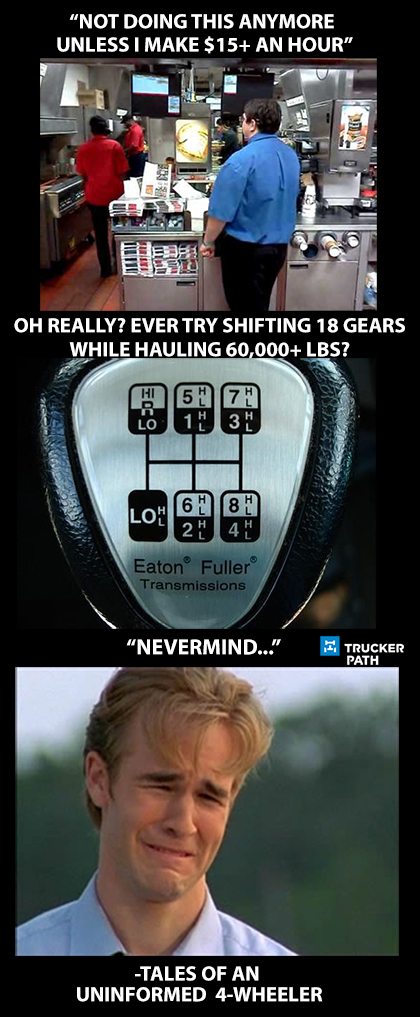
The misconceptions you hear from 4-wheelers about truck drivers can be laughable and frankly, absurd. At Trucker Path, we like to refer to these misconceptions of truck drivers as “Tales of an Uninformed 4-Wheeler”. Some are so crazy that all you can do is laugh at them.
Sometimes 4-wheelers just don’t understand what it’s like being a truck driver. Trucking requires learning an all new set of laws, regulations and the skill to drive an enormous big rig in some of the tightest spaces. It’s unlike any other career.

Why do trucks pass each other on the highway?
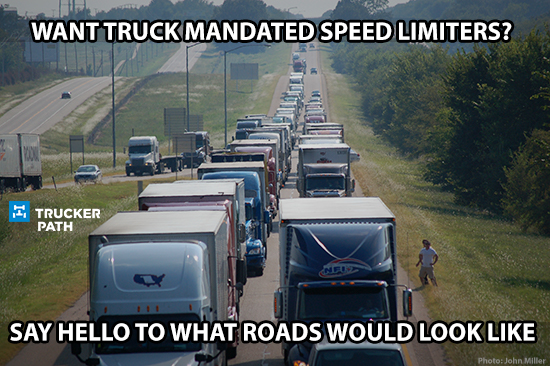
You hear this all the time. A 4-wheeler gets stuck behind a truck for a few seconds while the truck driver passes another big rig. There are several factors that play into this. It’s partly because some trucks are governed at a certain speed (some 60 mph) and some are governed at a higher mph or not at all. Also, some trucks carry much heavier loads than others. An incline in the road can also factor into this occurrence as some trucks hauling cargo uphill struggle to even go 50 mph. Due to this, some truck drivers have no choice but to pass a slower or heavier truck but at times, can only go a certain speed to pass.
Now the Department of Transportation has proposed a speed limiter for all commercial trucks weighing over 26,000 pounds. If the proposed truck speed limiters mandate passes, you will see a dramatic increase in this “inconvenient truck passing”.

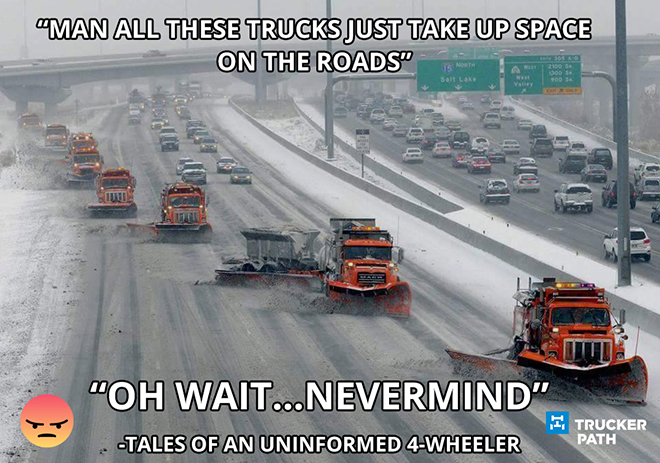
Then there are some 4-wheelers who think trucks are an inconvenience on the road altogether. Not only do truck drivers deliver 80 percent of all cargo in America, but they are used for disaster relief and various other tasks to make life easier for 4-wheelers.

Or the ones who think driving a truck is a simple job because all truck drivers have to do is sit in a chair.

Did we forget to mention that driving a truck is the deadliest job in America. In 2015, there were 745 truck driver fatalities, more than any other.
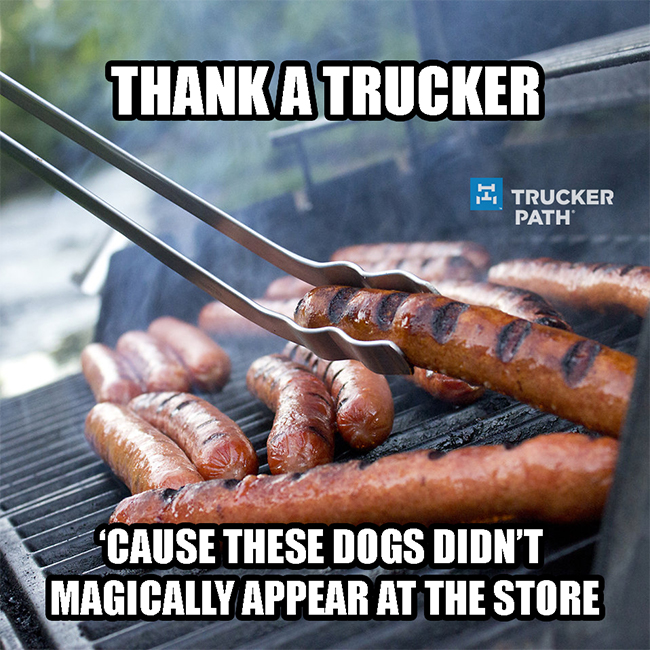
It’s time we debunk the myths about truck drivers. Don’t like trucks? Better rethink that one. Without truck drivers, shelves would be full of dust within a few days.


Brake Safety Week is almost here. Are you ready? [p]Are you ready for the Commercial Vehicle Safety Alliance’s (CVSA) Brake Safety Week happening later this month? From September 16-22, CVSA-certified inspectors will conduct a weeklong inspection blitz throughout the U.S. and Canada focusing on brake systems. CVSA reported that 14 percent of truck drivers were placed out-of-service for brake-related violations during last year’s Brake Safety Day. Getting placed out-of-service costs drivers valuable time and money, so it’s important that you don’t find yourself in the same situation. Making sure you’re prepared will not only help you pass an inspection and keep you moving, but it will also make our roadways a safer place.
[p]Most inspections during the blitz will be full Level I inspections. This comprehensive 37-step procedure examines driver operating requirements and vehicle mechanical fitness, and will also focus on the inspection of:
<ul>
<li>Brake-system components to identify loose or missing parts</li>
<li>air or hydraulic fluid leaks</li>
<li>defective rotor conditions</li>
<li>measurement of pushrod travel</li>
<li>mismatched air chamber sizes across axles</li>
<li>air reservoir integrity and mounting</li>
<li>worn linings, pads, drums or rotors</li>
<li>required brake-system warning devices</li>
<li>other brake-system components</li>
</ul>
[p]There will also be 12 jurisdictions using performance-based brake testing equipment to measure vehicle braking efficiency.
[p]So, what can you do to be ready for your inspection?
<ul>
<li>Have your driver’s license and registration easily available.</li>
<li>Perform your regular preventative maintenance procedures.</li>
<li>Conduct your pre-trip visual inspection. Make sure to look for loose hoses, leaks and any damage; check air disc brakes for cracks and grooving; and ensure air chambers are intact and in the correct position.</li>
<li>Inspect brakes more in-depth looking for leaks, checking brake linings for cracks and wear, and measuring the brake stroke, etc.</li>
<li>Utilize the Trucker Path app to see inspection facilities and get an idea of when you might expect to receive an inspection during the blitz.</li>
</ul>
[p]We hope these tips will help make your inspection go smoothly. It’s also important to remember that it’s a best practice to always keep your truck well-maintained, inspect your brake systems regularly, and perform a thorough pre-trip inspection before every trip. You still have time to address any issues and get yourself and your truck ready for the 2018 CVSA Brake Safety Week!
Christmas for Truckers
[p][b]Christmas for Truckers[/b][/p]
[p]Trucking is a demanding job that requires round the clock commitment. It is often several months before truck drivers can meet their friends and family, which also means that most truckers spend their time on the road during Thanksgiving, Christmas, and other major holidays.
[/p]
[p]However, there is no need to worry if you are a truck driver out on the field during the holiday season. There are still ways to enjoy the Christmas spirit.[/p]
<h2></h2>
[p][b]Christmas on the Road [/b][/p]
[p]You are not alone during the holidays, especially with all the other truckers who share the same grief. There are always a few feasts going on at truck stops, where you can either eat for free or get massive discounts. [/p]
[p]You may also enjoy a delicious Christmas dinner with your family and friends before or after Christmas Day. It is not necessary to match the exact dates since it is the thought that counts.
[/p]
[p]So, this Thanksgiving, we’d like to give thanks to our hard working truckers out there. Because of you, we enjoy delicious Thanksgiving meals and have goodies to look forward to every Black Friday. If we bought it, truckers brought it. [/p]
<h2></h2>
[p][b]Trucker Gift Suggestions[/b][/p]
[p]Here are some gift suggestions you may give to fellow truckers.[/p]
<li>Weighted Blanket - These blankets can help calm a restless body, reduce feelings of anxiety, and improve sleep troubles.</li>
[img src="https://truckerpath.com/uploads/2020/12/tp-blog-christmas_for_truckers_2020-1.jpg" alt=""]
<li>Beanie Hat - Helps warm during winter</li>
[img src="https://truckerpath.com/uploads/2020/12/tp-blog-christmas_for_truckers_2020-2.jpg" alt=""]
<li>Personalized Mud Flaps - Drive in style with these. </li>
<h2></h2>
[img src="https://truckerpath.com/uploads/2020/12/mudlflapstp1.jpg" alt=""]
<h2></h2>
[p][b]Final Thoughts[/b][/p]
[p]This Christmas, if you can’t be with family, there are a lot of ways to still enjoy the holiday mood. You can make this Christmas memorable by giving others some gifts, planning a delightful Christmas dinner with your best trucking buddies, or volunteering together at a truck stop to make the rookie drivers feel at home. Christmas is a time to be grateful for all the blessings you have received all year. Counting your blessings and thinking about all the good things that happened to you in the past year can help promote positivity and good vibes.
[/p]
[p]Lastly, all of us from Trucker Path, would like to wish you all a Merry Christmas!
[/p]
[p]How will you spend your Christmas? Share your plans in the comments section below. [/p]
<h2></h2>
<h2></h2>
[p][b]By Aldous Aldwin[/b][/p]
7 Tips on Healthy Eating For Truck Drivers [h2] Healthy Eating for Truck Drivers [/h2]
[p]It's never too late to rediscover healthy eating habits especially healthy eating for truck drivers. Here are seven tips to help promote better nutrition and healthy eating for truck drivers.[/p]
[p]Sure, it's easy to swing by a [a href="https://app.appsflyer.com/com.sixdays.truckerpath?pid=Social Facebook"]truck stop near you[/a] and grab a few cheese-smothered chili dogs, but that offers no nutritional benefits to healthy eating for truck drivers. The goal should be to create healthy habits and make it a lifestyle. These habits should be deeper than just what you eat, but also when you eat and how your shop for your food.[/p]
[h2]1. How Often Should I Eat?[/h2]
[p]Before we talk about shopping and cooking we should talk about something extremely important: eating. Our society and the trucking industry has been organized around the idea that people should only eat about 3 times a day. For healthy eating for truck drivers, this is not necessarily the best choice. [/p]
[p]While this might be more efficient in terms of consuming maximum calories in minimum time and getting back on the road, it is not always the best plan for your health. Instead, aim for around five smaller meals each day. This might seem crazy but it is necessary to metabolize food more efficiently.[/p]
[h2]2. How Our Body Processes Food[/h2]
[p]Your body is designed to absorb calories, use them for energy and then burn them off. In order for your body to make use of the food, what you eat has to be broken down into a form of sugar called glucose. This is a natural process and for most, the human body does this quite well. You have probably heard people talking about their “blood sugar level”, and what they are referring to is the amount of glucose in their blood.[/p]
[giphy]<iframe src="https://giphy.com/embed/kVVEP6SmfEXvy" width="480" height="269" frameBorder="0" class="giphy-embed" allowFullScreen></iframe>[/giphy]
[h2]3. Why Should I Care About My Blood Sugar Levels?[/h2]
[p]Your body has a normal range for the amount of [a href="https://thehungryhauler.com/"]glucose in your blood[/a] (between 4.0 and 11.0) and it has a beautiful system for managing that level. Hormones like insulin keep your blood sugar from getting too high and becoming toxic, and another awesome compound, glucagon keeps your sugar from getting too low and making you pass out. It is something like a highway with really good guard rails that keep a truck from running off the road.[/p]
[p]The only problem is that it is possible to overwhelm this excellent system and cause a wreck. Actually, many people are overwhelming it every day and causing small “fender benders” that lead to a total cataclysm later in life called diabetes.[/p]
[p]So why does this make eating only three times per day (or fewer) a bad idea? Because you can end up constantly overwhelming the system with extreme blood sugar highs and lows. If you wait to eat until you are extremely hungry and have very low blood sugar, your body will send the signal that you are starving, and when you do eat it is often much easier to overeat unhealthy and convenient food. Healthy eating for truck drivers requires you to eat when you're hungry and avoid a severe dip in blood sugar.[/p]
[h2]4. How Much Should I Be Eating?[/h2]
[p]Some people conclude that the solution is to simply eat drastically less overall and there is a grain of truth to this. While dramatically reducing your caloric intake does cause the body to burn stored fat to stay alive, it can signal your body to store everything you do eat, which results in rebound weight gain when you do return to a more normal diet. Starving yourself is not the answer.[/p]
[p]Thankfully there is a much better way. Simply, eat a reasonable amount of food more often. Eating five or six smaller and healthier meals per day is like steering down the middle of your lane instead of bouncing your truck off the guard rails all day. This practice will help you feel more content and stop your body from deciding to store fat for hibernation. Of course, if you eat more often and end up eating more food overall you will still have trouble being healthy. The objective is to eat an appropriate amount of food, in a more sustainable way. Typically, 2,000–2,500 daily calories are suggested; however, consulting a healthcare professional is the best way to understand what an appropriate daily caloric intake means for your individual health needs.[/p]
[giphy]<iframe src="https://giphy.com/embed/xtgZt3jZelFqU" width="480" height="269" frameBorder="0" class="giphy-embed" allowFullScreen></iframe>[/giphy]
[h2]5. What Are the Benefits to Eating More Often?[/h2]
[p]There is also an enormous safety benefit to eating more often and avoiding the blood sugar spikes: you are less likely to feel drowsy at the wheel. Most people have experienced the after dinner slump that makes it all but impossible to keep your eyes open after a big meal. That might be fine after Christmas dinner when you are lounging on the couch at home, but at work, behind the wheel of an 80,000 pound-plus rig, it can be a disaster.[/p]
[h2]6. How Do I Plan My Meals?[/h2]
[p]You might be wondering: how on earth is it possible to eat five or more meals per day? Who has the time to stop for food that often? There is a way to make your diet much simpler, more healthy, easier to sustain over the long term, and much less expensive! The key is to learn to shop for your own food and cook for yourself on the road. It is much easier than it may sound, and the rewards for your health and happiness are amazing! It will even allow you to have more freedom to implement your doctor's specific recommendations.[/p]
[h2]7. Eat What You Want. Sort of[/h2]
[p]Anyone who has dealt with eating healthier has heard the term portion control. Controlling what, how much, how often you eat and making sensible, sustainable choices is the path to solving many of the health risks of the trucking lifestyle. To eat healthier you don't have to give up all of your favorite foods and consume a spinach and carrot based diet like a rabbit. Instead of going to the extreme, eating a balanced diet will keep you “between the lines” and on the road to better health. Extremes are by nature quite unsustainable and will not help you. Just like over-steering on the highway to avoid a crash can actually end up killing you, bouncing from one diet extreme to another, like chili-dogs to rabbit food, will just leave your lifestyle in a bewildering wreck.[/p]
[giphy]<iframe src="https://giphy.com/embed/n2v0V9cSmTQnS" width="480" height="269" frameBorder="0" class="giphy-embed" allowFullScreen></iframe>[/giphy]
[p]The cornerstone of a healthy life is healthy eating for truck drivers. Eating healthy is difficult for truck drivers who are on the road for weeks at a time. Most trucks aren’t designed with a fully equipped kitchen or proper food storage. Even if you can manage to find space for some cooking gear, it is often difficult to consistently find time in a busy schedule to prepare a good meal. We all want to be around long enough to enjoy time with our families and loved ones. The best way to ensure this is to focus on eating healthier as a truck driver.[/p]
[p]By: [a href="https://thehungryhauler.com/"]John Heslop[/a][/p]